


Answer Engine Optimization (AEO): What It Is and How to Do It


Answer Engine Optimization (AEO): What It Is and How to Do It
TL;DR
Answer engine optimization (AEO) is the practice of structuring your content so search engines and AI assistants can pull it as a direct answer: in featured snippets, People Also Ask, voice search, Google AI Overviews and tools like ChatGPT and Perplexity. You do it by answering real questions clearly and early, using question-based headings, adding FAQ and other structured data, and building enough trust that answer engines choose your page as the source.
Key takeaways
- AEO targets answers, not just rankings. The goal is to be the one answer people see or hear, not one of ten blue links.
- AEO builds on SEO. Answer engines mostly pull from pages that are already indexed, crawlable and trusted.
- Format matters as much as content. A clear 40 to 60 word answer under a question heading is easier to extract than the same idea buried in a long paragraph.
- Structured data helps machines understand you. FAQ, HowTo, Article and Organization markup make your content easier to read for search engines and AI systems.
- Track visibility, not only clicks. Featured snippets, People Also Ask placements and AI mentions are the new AEO metrics.
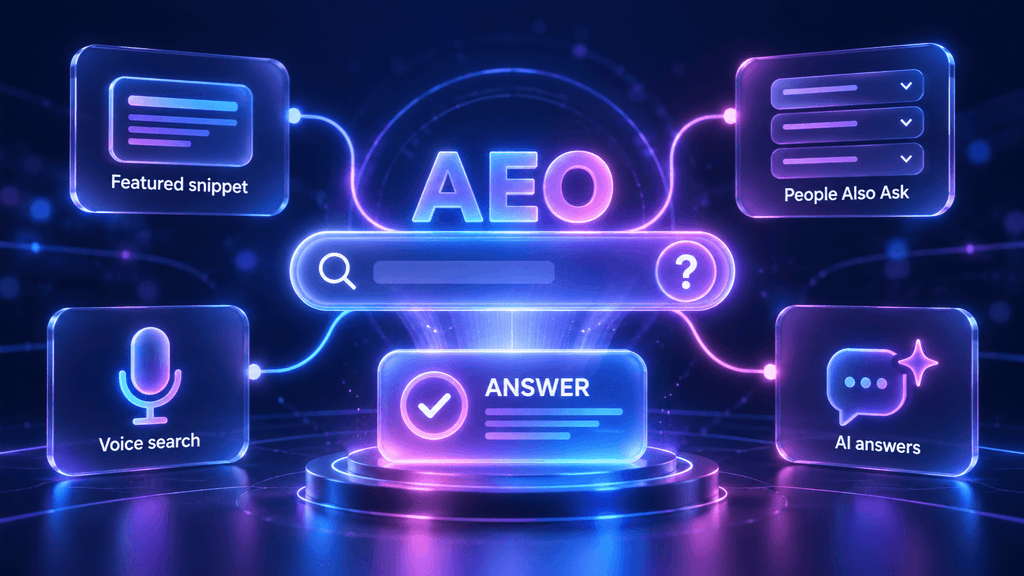
Search is no longer just a list of links. Google answers many questions right in the results, voice assistants read one answer out loud, and more people start their research in ChatGPT or Perplexity. If your page is not the answer, it is often invisible, even if it ranks on page one.
That is what answer engine optimization is for. In this guide you will learn what AEO is, how it compares to SEO and GEO, which answer engines matter, and a step-by-step checklist you can apply to any page today.
What Is AEO?
AEO, or answer engine optimization, is the process of optimizing content so that answer engines select it as a direct response to a user’s question. An answer engine is any system that gives the user an answer instead of, or before, a list of links.
Classic SEO asks “how do I rank this page higher?”. AEO asks “how do I make this page the best and easiest answer to extract?”. In practice, that means clear question-based structure, concise answers, supporting detail below them, and signals of trust and expertise.
Which Answer Engines Should You Optimize For?
AEO covers every place where a user gets an answer without scrolling through results:
- Featured snippets. The answer box at the top of Google results, usually a paragraph, list or table.
- People Also Ask. Expandable questions in Google results, each with a short answer from a web page.
- Google AI Overviews and AI Mode. AI-generated summaries that cite several sources.
- Voice assistants. Siri, Alexa and Google Assistant usually read a single answer aloud.
- AI assistants and AI search. ChatGPT, Perplexity, Gemini and Microsoft Copilot answer questions and cite or recommend sources.
The same well-structured page can appear in several of these at once. That is why AEO is worth doing even if you only care about Google.
AEO vs SEO vs GEO: What Is the Difference?
AEO, SEO and GEO overlap, but each one targets a different result.
| SEO | AEO | GEO | |
| Goal | Rank pages in search results | Be the direct answer to a question | Be mentioned and cited in AI-generated answers |
| Where you appear | Organic Google and Bing results | Featured snippets, People Also Ask, voice search, AI Overviews | ChatGPT, Gemini, Perplexity, Copilot, AI Overviews |
| Main signals | Relevance, backlinks, technical health, content quality | Clear answers, question-based structure, structured data | Brand mentions, entity clarity, trusted sources, citable content |
| Key metric | Rankings, clicks, organic traffic | Snippets, PAA placements, answer visibility | AI mentions and citations |
The short version: SEO gets you into the results, AEO gets you into the answer box, and GEO gets your brand into AI conversations. We cover the last one in detail in our guide to GEO vs SEO.
Why AEO Matters Now
More searches end without a click because the answer is already on the results page. When Google shows an AI Overview or a featured snippet, the page that provides that answer gets the visibility, and often the trust, even if fewer people click.
AEO also protects the traffic you already have. If a competitor’s page is easier to extract, Google and AI assistants may quote them instead of you, even when you rank higher. And because answer engines prefer clear, well-structured content, AEO usually improves your regular SEO at the same time.
How to Do Answer Engine Optimization: Step by Step
Step 1. Find the questions your audience asks
Start with real questions, not keywords alone. Look at the People Also Ask box for your main topics, related searches, Google Search Console queries that start with “how”, “what”, “why” or “can”, and questions from sales calls and customer emails. Group them by topic so each page answers one main question and a few related ones. Our guide on People Also Ask shows how to collect these questions.
Step 2. Use questions as headings
Turn the most important questions into H2 or H3 headings, using the same words people type or say. A heading like “How long does SEO take to work?” matches the query far better than “Timeframes”.
Step 3. Answer first, then explain
Put a direct answer of 40 to 60 words right under each question heading. Start with the answer itself, not with background. Then add details, examples and exceptions below. This “answer first” format is what featured snippets, voice assistants and AI Overviews look for.
Step 4. Match the answer format to the question
Use a paragraph for “what” and “why” questions, a numbered list for “how to” steps, a bulleted list for options, and a table for comparisons, prices or specs. Google often shows the same format in the snippet that the page uses.
Step 5. Add structured data
Mark up your content with schema: FAQPage for question and answer sections, HowTo for step-by-step guides, Article for blog posts and Organization for your brand details. Structured data does not guarantee a snippet, but it helps search engines and AI systems understand what each part of the page is.
Step 6. Make your expertise and brand clear
Answer engines prefer sources they trust. Show who wrote the content and why they are qualified, keep your business information consistent across the web, and back up claims with your own data and examples. Pages with real first-hand experience are more likely to be quoted.
Step 7. Keep pages fast, crawlable and up to date
None of this works if the page is slow, blocked in robots.txt or full of technical errors. Make sure search engine and AI crawlers can access your key pages, and update answers when facts change. Outdated answers lose snippets quickly.
Step 8. Track your answer visibility
Check which of your keywords show featured snippets and People Also Ask, and whether your pages win them. Ask ChatGPT, Perplexity and Gemini the questions your customers ask and note whether your brand appears. Repeat monthly and improve the pages that are close but not yet selected.
AEO Checklist (Copy and Use)
Use this checklist for every page you want to turn into an answer.
| Check | What to do | Why it matters |
| Main question | One clear question the page answers | Answer engines match one intent per answer |
| Question headings | H2/H3 written as real questions | Matches how people search and speak |
| Direct answer | 40 to 60 words right under the heading | Easy to extract for snippets and voice |
| Supporting detail | Examples, steps, exceptions below the answer | Shows depth and expertise |
| Right format | Paragraph, list or table based on the question | Google often mirrors the page format |
| FAQ section | 4 to 6 real follow-up questions | Covers People Also Ask and AI follow-ups |
| Structured data | FAQPage, HowTo, Article, Organization | Helps machines understand the content |
| Author and brand | Author bio, consistent business details | Builds trust for answer selection |
| Technical health | Fast, indexable, not blocked for crawlers | Answer engines can only use pages they can read |
| Freshness | Review answers at least twice a year | Outdated answers lose placements |
Example: Turning a Paragraph into an Answer
Here is the same information written two ways for the question “How long does SEO take to work?”.
Before (hard to extract):
“SEO is a long-term strategy that depends on many different factors, and every website is unique, so it is difficult to say exactly how long it takes, but in general businesses should be patient and focus on quality over time.”
After (answer first):
“SEO usually takes 3 to 6 months to show steady results. Technical fixes and on-page changes can bring first improvements in 4 to 8 weeks, while competitive niches may need 6 to 12 months. The timeline depends on your site’s current state, competition and how consistently you publish and build authority.”
The second version answers the question in the first sentence, gives specific ranges and explains what affects them. That is the version Google and AI assistants are likely to quote.
Answer Engine Optimization Tools
You do not need a special platform to start with AEO. These tools cover most of the work:
- Google Search Console. Shows question queries that already bring impressions to your pages.
- Ahrefs or Semrush. Show which keywords trigger featured snippets, People Also Ask and AI Overviews, and who currently owns them. Ahrefs Brand Radar also tracks brand mentions in AI answers.
- AlsoAsked or AnswerThePublic. Map the questions people ask around a topic.
- Google Rich Results Test and Schema Markup Validator. Check that your structured data is valid.
- ChatGPT, Perplexity and Gemini. Test your main questions manually and see which sources they cite.
Common AEO Mistakes
- Burying the answer. Long introductions before the actual answer make the page hard to extract.
- Writing for keywords, not questions. Headings like “Benefits” or “Overview” do not match how people ask.
- One page for every tiny question. Thin pages rarely win answers. Group related questions on one strong page.
- Adding schema that does not match the page. FAQ markup must reflect questions and answers that are visible on the page.
- Ignoring trust signals. Anonymous content without experience or sources is less likely to be chosen.
- Forgetting about SEO basics. If the page is not indexed or loads slowly, no answer engine will use it.
How SEO F1RST Approaches AEO
At SEO F1RST, AEO is part of every content and SEO project, not a separate add-on. We start by mapping the questions your customers ask in Google and in AI assistants, then restructure key pages so each question gets a clear, answer-first section with the right format and structured data. Together with technical SEO and GEO, this helps your content appear in featured snippets, People Also Ask, AI Overviews and AI answers. Learn more about our AI SEO services.
If you are planning new articles with AEO in mind, our guide to creating an SEO content brief shows how to build these requirements into every brief.
FAQ: Answer Engine Optimization
What is AEO in SEO?
AEO, or answer engine optimization, is the part of SEO that focuses on getting your content selected as a direct answer in featured snippets, People Also Ask, voice search, AI Overviews and AI assistants. It uses question-based headings, concise answers and structured data to make content easy to extract.
Is AEO replacing SEO?
No. AEO builds on SEO. Answer engines mostly use pages that are already indexed, technically healthy and trusted, so strong SEO is the foundation. AEO adds a layer focused on how your content is structured and answered.
What is the difference between AEO and GEO?
AEO focuses on direct answers such as featured snippets, People Also Ask and voice search. GEO, generative engine optimization, focuses on getting your brand mentioned and cited in AI-generated answers from tools like ChatGPT, Gemini and Perplexity. The two overlap, and the same answer-first content supports both.
How long should an answer be for AEO?
For most questions, aim for 40 to 60 words in the first answer under the heading. That is long enough to be complete and short enough for a featured snippet or a voice assistant. Add more detail in the paragraphs below.
How do I measure AEO results?
Track how many featured snippets and People Also Ask placements your pages win, check impressions for question queries in Google Search Console, and test whether ChatGPT, Perplexity and Google AI Overviews mention or cite your brand for your key questions.
About the author
Vadym Romakh, SEO and GEO Specialist at SEO F1RST
Vadym has more than 10 years of experience in SEO and leads SEO and GEO strategy for ecommerce, Shopify and B2B brands at SEO F1RST. He holds Semrush certifications in AI search optimization and builds AI-assisted workflows for SEO audits and AI visibility tracking.
Want to know if your brand shows up in AI answers?
We run a free SEO and AI visibility audit that shows where you rank in Google and how often ChatGPT, Gemini, Perplexity and AI Overviews mention your brand. Get your free audit and a clear plan for what to do next.


