


Supplement SEO: 17x Organic Traffic Growth
How we grew organic traffic from 70 to 1,200+ daily sessions for a supplement eCommerce store




Overview
How our supplement SEO services grew a Shopify store from 70 to 1,200+ daily organic sessions
This supplement SEO case study shows how our SEO for a supplement company on Shopify helped turn a near-flat blog and store into a steady source of organic traffic. Between January 1 and September 20, 2026, daily organic sessions grew from about 70 to more than 1,200, and the store recorded 91,904 form starts from 64,603 users.
The project began with a full technical SEO audit, keyword and competitor research and an analysis of how the store’s products matched real search demand. Supplement company SEO is YMYL SEO (Your Money or Your Life), so trust signals and content quality mattered as much as rankings. Like any ecommerce SEO case study on our site, every number below comes from GA4, Search Console and Ahrefs.
Based on this research, we built a strategy around four connected areas:
- Technical Shopify SEO
- Keyword research and competitor analysis
- Ingredient-focused content and E-E-A-T
- Link building and authority growth
Classic search engine optimization stayed the foundation, while answer-ready formatting prepared the content for Google AI Overviews and AI assistants.
Initial Data
Niche: Health supplements ecommerce
Platform: Shopify
Market: United States, highly competitive YMYL niche
Project type: Long-term SEO, content and link building
Starting point:
- 50 to 90 organic sessions per day
- Few non-branded rankings for product and ingredient queries
- A blog that brought almost no search traffic
- Domain Rating of 26 and a modest backlink profile
- Content not structured for AI Overviews and AI answers
Client request:
- Grow organic traffic from Google
- Rank for ingredient and “best supplement” queries
- Turn the blog into an entry point for product pages
- Build trust signals for a YMYL niche
- Increase leads and sales from organic search
Client Background
The client sells physician-formulated, third-party tested supplements: berberine, magnesium glycinate, psyllium husk, beetroot, saffron, Ceylon cinnamon and more. The catalog is organized by health goals such as metabolic, heart, brain and sleep health.
The supplement market is crowded with large brands and marketplaces, and Google applies strict quality standards to health content. To compete, the store needed content that answers real buyer questions, from “which berberine is best” to “who should avoid beetroot”, backed by clear sources and expert positioning.
SEO Services for a Supplement Company
Technical Shopify SEO
We fixed the technical issues that held back crawling, indexing and page experience:
- Crawling and indexing analysis in Google Search Console
- Canonical setup for duplicate collection and product URLs
- Product, Article, FAQ and Breadcrumb schema
- Core Web Vitals and mobile improvements
- Clean blog and collection architecture
This gave the store a stable base before the content and link building work scaled up.
Keyword Research & Competitor Analysis
We mapped search demand for every ingredient in the catalog and compared it with the pages competitors ranked for:
- Ingredient and benefit queries (“beetroot benefits for female”)
- Commercial comparison queries (“best berberine supplement”)
- Safety and side-effect queries (“psyllium husk cancer warning”)
- Content gap analysis against large supplement brands
Each cluster was tied to the product page it supports, so informational traffic had a clear path to purchase.
Ingredient-Focused Content & E-E-A-T
Our content writing team built topic clusters around each key ingredient:
- “Best supplement” buying guides for berberine, saffron and Ceylon cinnamon
- Benefit articles by audience (women, men, kids)
- Honest safety content: who should avoid an ingredient and why
- Comparison articles, such as Ceylon vs Saigon cinnamon
- Internal links from every article to the matching product
For a YMYL niche, every article followed clear sourcing rules, expert positioning and direct-answer formatting. This made the content easy to trust for readers and easy to quote for Google AI Overviews.
Link Building & Authority
Through steady link building, we strengthened the domain’s authority:
- Domain Rating growth from 26 to 36
- Relevant links from health, wellness and lifestyle sites
- Links to buying guides and key product pages
Authority growth helped new articles reach the first page faster and hold their positions.
The Results of Supplement SEO
Organic Traffic Growth
17x growth in daily organic sessions 70 to 1,270 daily sessions (January vs September 20) 9 months from launch to results
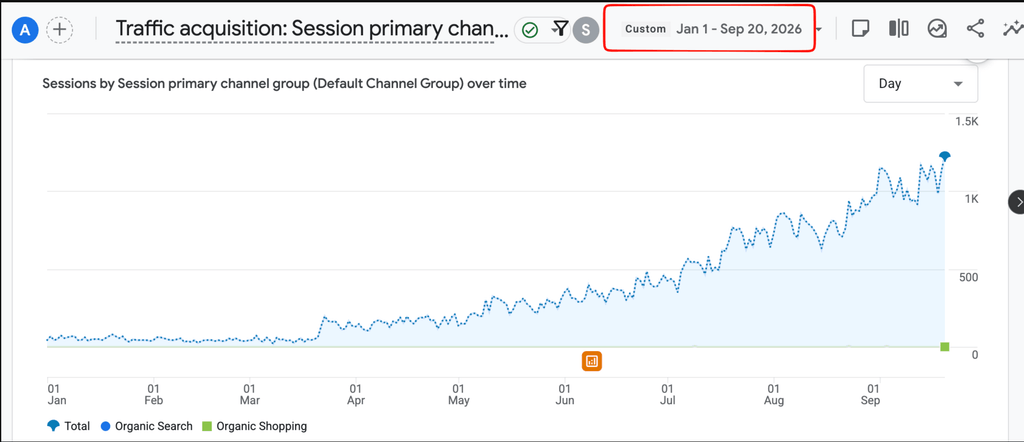
Traffic grew step by step, with each phase building on the previous one:
- January to mid-March: 50 to 90 sessions per day while we fixed technical issues and built the content plan
- Late March: the first content cluster was indexed and daily traffic jumped to 200+
- April to June: steady growth to 400 to 500 sessions per day
- July to August: 600 to 950 sessions per day as buying guides reached the top of Google
- September: over 1,000 sessions per day, with a peak of 1,270
Conversions
91,904 form starts 64,603 users who started a form 1.42 form starts per user

Every form start is a visitor who moved from reading to action: subscribing, asking a question or starting an order. Organic content became a lead source, not only a traffic source.
Rankings & Authority
According to Ahrefs, the store’s estimated organic traffic value grew from about $8 to $2,900 per month, and Domain Rating rose from 26 to 36. The site now holds #1 positions in Google for high-intent ingredient queries:
| Keyword | Monthly volume | Position |
| beetroot benefits for female | 10,000 | #1 |
| best berberine supplement | 7,100 | #1 |
| best saffron supplement | 3,100 | #1 |
| saffron for kids | 2,600 | #1 |
| what is saigon cinnamon | 2,400 | #1 |
| psyllium husk for dogs | 2,200 | #1 |
| who should avoid beetroot | 1,500 | #1 |
| best ceylon cinnamon | 1,400 | #1 |
The best berberine buying guide alone ranks for 111 keywords and sends visitors straight to the product page.
We tracked performance with Google Search Console, Google Analytics (GA4), Ahrefs and Screaming Frog.
Success Factors of Supplement SEO
- Full technical SEO audit before content scaling
- Shopify-specific technical fixes
- Ingredient-level keyword research
- Competitor and content gap analysis
- Topic clusters linked to product pages
- Buying guides for “best supplement” queries
- Honest safety and side-effect content
- E-E-A-T and YMYL content standards
- Steady link building and DR growth
- Conversion tracking in GA4 from day one
This project shows that supplement company SEO can compete with large brands in a YMYL niche when technical SEO, trustworthy content and authority grow together. You can see similar results in our Shopify SEO case study with +790% organic growth and in our ecommerce SEO + GEO case with 461 AI responses.
FAQ
How long does supplement SEO take?
In this project, the first traffic jump came about 3 months after the start, and traffic grew 17x within 9 months. Timelines depend on competition, domain authority and how fast new content is published.
Why is SEO for a supplement company harder?
Supplements are a YMYL niche, so Google expects accurate, well-sourced content and clear trust signals. Stores that publish honest buying guides and safety content earn rankings that thin product pages cannot.
What do supplement SEO services include?
Our SEO services for health supplement brands cover a technical audit, keyword research by ingredient, content (buying guides, benefit articles and safety content), link building and GA4 conversion tracking. Each article links to the matching product so readers have a clear next step.
Can a Shopify supplement store rank against big brands?
Yes. In this case, a Shopify store reached #1 positions for queries like “best berberine supplement” and “best saffron supplement” by combining Shopify SEO, focused content and steady link building.

