


Why Is an SEO Audit Important? 9 Benefits for Your Business


Why Is an SEO Audit Important? 9 Benefits for Your Business
An SEO audit is important because it shows exactly what stops your website from ranking and winning customers: technical errors, weak content, missing keywords and poor links. It turns those problems into a prioritised fix list, so you grow traffic, leads and visibility in Google and AI answers without wasting budget on changes that don’t matter.
What is an SEO Audit?
An SEO audit is like a check-up for your website. It looks at things that affect how well your site shows up in search results. This includes any technical problems, the quality of your content, and how other websites link to it. A good SEO audit helps you find and fix issues so your site can reach its full potential.
An SEO audit is a process that analyzes a website’s performance and finds ways to improve it. It looks at things like:
- Technical SEO – Checking if search engines can easily find, understand, crawl and index a website.
- On-Page SEO – Checking optimization of various elements of the site for better ranking and attracting more users by answering their queries as accurately as possible
- Off-Page SEO – Analysis of a strategy for conducting off-site activities to improve its visibility, increase trust in the site and brand
- Local SEO – Estimation of the efficiency of displaying the site in local search and on maps and develop, identification of the main problems that impair website visibility for local users
- Ranking analysis – study of site ranking trends and identification of reasons for the deterioration of positions
- Traffic reduction – research of the causes of the traffic deterioration.
- Competitor analysis – brief analysis of ranking trends and competitors’ traffic growth, identification of the main factors of these positive changes
By doing an SEO audit, businesses can make sure their website is working properly and following best practices to rank higher in search results.
A strong SEO audit also helps businesses understand how traditional search performance connects with emerging AI-driven search models, making the distinction between GEO vs SEO increasingly important.
Purpose of an SEO Audit
The main goal of an SEO audit is to find and fix problems that stop a website from ranking high in search results and AI overviews. Search engines like Google look at many things to decide which websites to show first. If a site loads slowly, has broken links, or doesn’t use the right keywords, it may not appear at the top. An SEO audit finds these problems so they can be solved. This helps businesses improve their website and attract more visitors.
9 Benefits of an SEO Audit
Here are the 9 main benefits of an SEO audit for your business:
- Finds technical issues: shows crawl, indexing, speed and mobile errors that stop Google from ranking your pages.
- Higher search rankings: fixes what holds your key pages back, so they move closer to the first page.
- More organic traffic and leads: better rankings bring more visitors who are already looking for what you sell.
- Visibility in AI search: checks whether Google AI Overviews, AI Mode and ChatGPT can understand and cite your pages.
- Better user experience and conversions: removes broken links, slow pages and confusing navigation that make visitors leave.
- Stronger content: finds missing keywords, thin pages and duplicate content, and shows what to update first.
- Recovered traffic: explains drops after algorithm updates, redesigns or CMS migrations and shows how to win traffic back.
- Competitive advantage: shows what competitors do better and where you can overtake them.
- Smarter SEO budget: ranks every fix by impact and effort, so you spend money on what actually brings customers.
In short, an SEO audit turns guesswork into a clear plan. If you want to see these benefits on your own website, our SEO audit service covers all nine areas.
Signs of a quality SEO audit
The document should :
- contain an in-depth analysis of all components of the audit;
- show the degree of importance of each error and the priority of correction of each identified problem, as well as how much the error affects the attraction of new customers;
- have an estimate of the complexity of correcting the problem;
- provide a general or detailed algorithm (depending on the degree of co-operation) of actions to improve the situation and achieve top positions in search.
- Relate the prioritisation of error correction to the company’s business objectives.
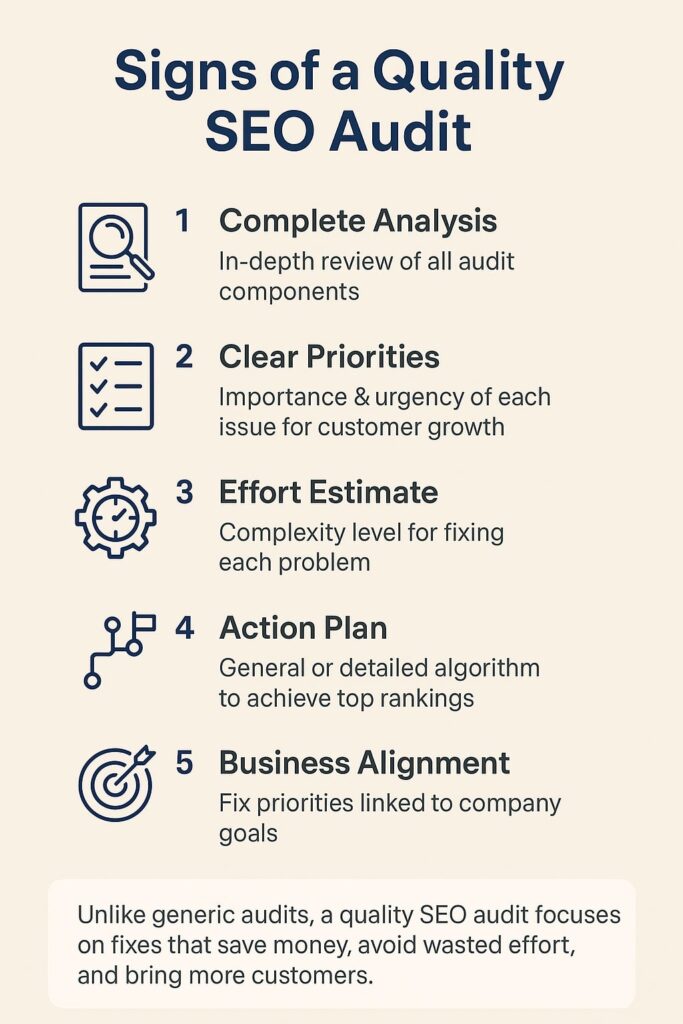
Most audits are simply a list of website problems, where it’s easy for a business owner to get lost and drain their entire budget on fixing little meaningful errors. A quality audit allows website owners to direct their efforts in the most effective direction, thereby saving money and increasing the potential to get more customers.
These are the principles our company adheres to when evaluating and verifying our clients’ websites.
Why an SEO Audit Matters for AI Search
Search is no longer just ten blue links. Google AI Overviews, AI Mode and ChatGPT answer questions directly and cite only a few sources. If these tools can’t crawl your site, or your pages don’t give clear answers, your competitors get the mention instead of you.
A modern SEO audit checks your AI search readiness too:
- Crawl access: whether Googlebot and AI crawlers such as GPTBot can reach your important pages.
- Answer-ready content: whether key pages answer common questions in the first two or three sentences.
- Structured data: whether schema markup helps search engines and AI tools understand your business, services and FAQ.
- Entity signals: whether your brand, authors and contact details are consistent across your site and the web.
- AI visibility: whether your pages already appear in AI Overviews and which questions trigger them.
This is where SEO meets GEO (Generative Engine Optimization). Fixing these points helps you rank in classic search and get cited in AI answers at the same time.
Technical Aspects of SEO Audits
A big part of an SEO audit is checking the technical side of a website. Search engines need to crawl and index pages properly to rank them. If a site has technical issues, it can hurt rankings.
Key technical factors in an SEO audit include:
- Website Speed – A slow site can drive visitors away. Faster websites rank higher.
- Mobile-Friendliness – Google ranks mobile-friendly sites better because most people search on phones.
- Broken Links & Errors – If a site has too many broken links or pages that don’t load (404 errors), it affects SEO.
- Secure Website (HTTPS) – A secure website builds trust with users and search engines.
Fixing technical SEO issues helps search engines understand the website better and improves rankings.
Content Strategy Improvements
Content is one of the most important parts of SEO. If a website has outdated, low-quality, or missing content, it won’t rank well. An SEO audit helps improve content by:
- Finding Missing Keywords – Checking if the right keywords are being used in important pages.
- Updating Old Content – Keeping articles and product pages fresh and relevant.
- Improving Readability – Making content easy to read and understand.
- Fixing Duplicate Content – Avoiding repeated content that confuses search engines.
By improving content strategy, a website can rank for more keywords and attract the right audience.
One-Time SEO Audit or Regular Audits?
A one-time audit is a good start: it shows what is broken today and what to fix first. But search engines, AI tools and your competitors keep changing, so new issues appear every few months. That’s why most businesses get the best results from one full audit followed by regular check-ups. Regular audits help you:
- Keep up with Google algorithm updates and changes in AI search.
- Catch new technical and content issues before they cost you traffic.
- Make sure earlier fixes still work after site updates or redesigns.
- Grow rankings step by step instead of fixing problems in a rush.
Why You Can’t Wait
Every month your website runs with hidden errors, it loses visitors to competitors who have already fixed theirs. Imagine two websites with similar products, prices and brand trust. One has technical errors, the other doesn’t. Google will rank the second one higher and show it more often, so it gets the customers. An SEO audit makes sure that website is yours.
Real Results: What Our SEO Audits Found and Fixed
Want an audit that ranks every fix by business impact, not just a list of errors? Talk to our team.case studies.
Case 1. Duplicate pages and content.
Result: lost traffic came back, and total traffic grew by 10 to 30%, depending on the niche and the number of issues.
Case 2. Pages lost during a CMS migration.
Result: restoring them brought a 1 to 2% traffic lift for a technology website and an 80 to 90% traffic increase for a women’s clothing store.
Case 3. A mobile layout bug on a national local-services website: on one screen size, the call button went off the screen.
Result: fixing it increased conversions by 1%.
Case 4. Incorrect redirects.
Result: fixing them increased the engagement rate by 2%.
Case 5. Poor text readability on a web design website.
Result: after the texts were simplified, the engagement rate grew by 1.3%.
You can check the readability of your own texts with our Free Flesch Kincaid Calculator.
Key Takeaways
An SEO audit is important because it shows what stops your website from ranking, getting cited in AI answers and winning customers, and tells you what to fix first.
Key benefits include:
- An audit finds the technical, content and link issues that hold your site back.
- Fixing them brings higher rankings, more organic traffic and more leads.
- A modern audit also checks your visibility in AI Overviews, AI Mode and ChatGPT.
- A prioritised plan helps you spend your SEO budget where it matters most.
Want to know what is holding your website back? Contact SEO F1RST for a professional SEO audit and a clear plan to grow your traffic.
FAQ
What is the main purpose of an SEO audit?
The main purpose of an SEO audit is to identify and fix issues that prevent a website from ranking well in search engines. It ensures that the site is optimized for both users and search engines by analyzing technical performance, content quality, keyword usage, and external linking.
How often should I perform an SEO audit?
It’s best to perform an SEO audit every 6 months. Regular audits help you keep up with algorithm updates, fix new issues
as they appear, and make sure your site continues to meet SEO best practices and user expectations.
Audits may be unscheduled if:
- The site has been hacked.
- Change of site owner.
- Google sanctions have been applied
- Constant drop in traffic and pages falling out of the index.
Can an SEO audit help increase website traffic?
Yes, by identifying and resolving SEO issues, an audit can improve your website’s visibility in search engines. This leads to higher rankings, which attract more organic traffic and potential customers.
Do you perform SEO audits?
Yes, SEO audit is part of the standard promotion for SEOF1RST’s clients. The audit can also be performed separately as a single service.
Is there a free (trial) SEO audit service?
No. The company does not do a free audit, because any service of the company is aimed at deep dive into the client’s business processes and deep analysis of all technical and other SEO factors.
We have a free assessment of the potential of website promotion. contact us to find out more about this free offer
Looking to improve the readability of your content? Try our free Flesch Kincaid Calculator to instantly check how easy your text is to understand. It’s simple, fast, and completely free.


