


SEO Content Brief: Template and How to Create One with AI


SEO Content Brief: Template and How to Create One with AI
TL;DR
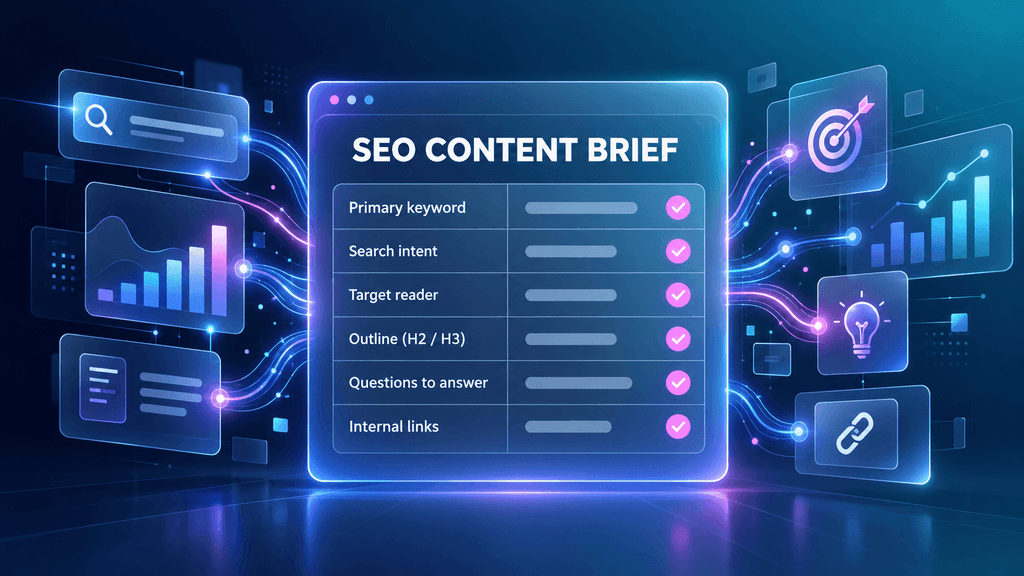
An SEO content brief is a one or two page document that tells a writer which keyword to target, who the reader is, what to cover and how to structure the article. Use the template below, let AI handle the research, and add your own data and expertise so the article can rank in Google and get cited in AI search.
Key takeaways
- A brief is more than an outline. It explains the keyword, search intent, reader, questions to answer and internal links, not just the headings.
- AI speeds up research, people add value. Use AI to draft the brief in minutes, then add your own numbers, examples and expert input.
- Templates save time. The same 15-field template works for almost any blog article.
- Plan for AI search from the start. Answer-first sections, clear entities and an FAQ make content easier for ChatGPT and AI Overviews to quote.
- Short briefs get used. If a writer cannot read the brief in five minutes, it is too long.
A content brief is the document a writer gets before they start writing. It tells them who the article is for, what it needs to cover, which keywords matter and what “good” looks like. A strong brief is the difference between an article that ranks and one that needs three rounds of edits.
Most briefs fail for a simple reason: they are either a keyword list with no direction, or a generic outline that any AI tool could produce. In this guide you will find what an SEO content brief should include, a template you can copy, a filled-in example, and a step-by-step way to build an AI content brief in about 20 minutes, without losing the expertise that makes content worth reading.
What Is an SEO Content Brief?
An SEO content brief is a short planning document that connects search data with editorial direction. It answers three questions before a single word is written: what the reader is looking for, what the page needs to cover to be the best answer, and how the content will be structured so search engines and AI assistants can understand it.
A brief is not the same as an outline. An outline is just the list of headings. A brief also explains why each section is there, which questions it must answer, what sources to use and what the writer should avoid.
Why Content Briefs Matter More in the Age of AI Search
Today anyone can generate a 2,000-word article in a minute. That is exactly why so much content looks the same. Google and AI assistants like ChatGPT, Gemini and Perplexity increasingly pick pages that give specific, direct answers backed by real experience.
The brief is where that experience gets into the article. It is the place to add your own data, examples, opinions and the questions your customers actually ask. Without it, writers, human or AI, fall back on the same generic points everyone else has already published.
What to Include in an SEO Content Brief
You do not need a ten-page document. These are the elements that make the biggest difference:
- Primary keyword and search intent. One main query and what the searcher wants: to learn, compare or buy.
- Secondary keywords. Close variations and related terms the article should cover naturally, not repeat.
- Target reader. Who they are, what they already know and what problem brought them here.
- Working title and H1. A clear title that includes the main keyword.
- Heading structure. H2 and H3 headings with a one-line note on what each section must answer.
- Questions to answer. Real questions from People Also Ask, customer emails and sales calls.
- Unique angle. What this article will have that the current top results do not: data, an example, a template, a strong opinion.
- Expertise to include. Who on your team has first-hand knowledge and what they should add.
- Internal links. Which pages on your site the article should link to and with what anchors.
- Length and format. An approximate word range, plus tables, lists or images that will help the reader.
SEO Content Brief Template (Copy and Use)
Copy this template into a doc or spreadsheet and fill it in for every new article.
| Field | What to fill in |
| Primary keyword | One main query, for example “seo content brief” |
| Search intent | Informational, commercial or transactional |
| Secondary keywords | 4 to 8 related queries |
| Target reader | Role, level of knowledge, main problem |
| Working title | Title with the primary keyword |
| Meta description | 140 to 160 characters with a clear benefit |
| Angle | What makes this article better than the top 5 results |
| Outline | H2 and H3 headings with a note under each |
| Questions to answer | 5 to 10 real questions from search and customers |
| Expert input | Who adds what: quotes, data, examples |
| Internal links | Pages to link to and suggested anchors |
| Word count | A range based on the current top results |
| Visuals | Tables, screenshots, diagrams |
| Do not | Topics, claims or phrases to avoid |
| Deadline and reviewer | Who checks the draft and when |
Example: A Content Brief Filled In
Here is what a short brief looks like for a local service business that wants an article about furnace repair costs.
- Primary keyword: furnace repair cost
- Search intent: informational with commercial intent: the reader has a problem and is close to calling someone
- Target reader: a homeowner whose furnace stopped working and who wants to know if repair is worth it
- Angle: real price ranges from the company’s own jobs plus a simple “repair or replace” checklist
- Outline: What affects the cost / Typical costs by repair type (table) / Repair or replace: 5 questions to ask / When to call a technician right away / How to avoid repeat breakdowns
- Questions to answer: How much does it cost to fix a furnace? Is it worth repairing a 15-year-old furnace? How long does a repair take?
- Expert input: a lead technician explains the three most common failures they see each winter
- Internal links: furnace repair service page, furnace replacement page, maintenance plan page
- Do not: promise exact prices without seeing the system
Notice how much of this brief comes from the business itself. That is what keeps the article from sounding like every other one on page one.
How to Create a Content Brief with AI (Step by Step)
AI is great at the research-heavy part of a brief. It is not great at knowing your business. The best workflow uses AI for speed and people for judgment.
Step 1. Choose the keyword and check the intent
Pick one primary keyword and search it yourself. Look at the top results: are they guides, product pages, lists or tools? Your article needs to match that format, or Google will not consider it a good answer.
Step 2. Review the top results and find gaps
Open the top five pages and note what they cover, how long they are and what they are missing. Outdated data, no examples or no template are all gaps you can fill.
Step 3. Collect real questions
Take questions from the People Also Ask box, related searches, your sales team and customer emails. These questions often become your H2 and H3 headings and your FAQ.
Step 4. Ask AI for a first draft of the brief
Give the AI tool everything you collected and ask for a structured brief. For example:
(Quote)
“Create an SEO content brief for the keyword [keyword]. The reader is [reader]. The search intent is [intent]. Here are the questions people ask: [list]. Here is what the top results miss: [gaps]. Suggest a title, meta description, H2 and H3 outline with a note for each section, and internal link ideas.”
Step 5. Add what AI cannot know
This is the most important step. Add your own data, examples, prices, mistakes you have seen, and the name of the expert who will contribute. Remove any section that only repeats what every competitor already says.
Step 6. Check facts and finalize
AI tools can produce confident but wrong statements. Check every number and claim before it goes into the brief. Then make sure the brief is short enough that a writer will actually read it.
How to Brief Content for AI Search (GEO)
If you want your article to be quoted in Google AI Overviews or recommended by ChatGPT, the brief has to plan for it. This is the core of GEO, generative engine optimization. Add these instructions to every brief:
- Answer first. Start each section with a direct one or two sentence answer, then explain.
- One idea per section. Clear headings and short sections are easier for AI systems to quote.
- Name things clearly. Use full names of products, places, tools and concepts, not vague references.
- Include real numbers and examples. Specific data gets cited, generic advice does not.
- Add an FAQ. Short questions and answers match how people talk to AI assistants.
- Plan structured data. Article and FAQ schema help search engines understand the page.
We use the same approach in our AI SEO services, where content is planned for both Google rankings and AI visibility.
Common Content Brief Mistakes
- Only keywords, no direction. A list of terms does not tell the writer what to say.
- Copying the competitors’ outline. You end up with the same article that is already ranking, just later.
- No expert input. Without first-hand experience, the article sounds generic to readers and to Google.
- Too long to read. If the brief takes longer to read than to write the article, nobody will follow it.
- No internal links. New articles should support your service pages and related posts from day one.
How SEO F1RST Writes Content Briefs
At SEO F1RST, every article starts with a brief. We combine keyword and competitor research with questions from real customers, then add what only the client knows: their numbers, cases and opinions. Each brief also includes instructions for AI search, so the finished article is ready for Google, AI Overviews and ChatGPT. If you want content planned and written this way, take a look at our content writing services.
FAQ: SEO Content Brief
What is a content brief in SEO?
An SEO content brief is a planning document that tells a writer which keyword to target, who the reader is, what to cover and how to structure the article. It connects search data with editorial direction, so the content matches search intent from the first draft.
What is a content brief in SEO?
An SEO content brief is a planning document that tells a writer which keyword to target, who the reader is, what to cover and how to structure the article. It connects search data with editorial direction, so the content matches search intent from the first draft.
How long should a content brief be?
Most good briefs fit on one or two pages. They should be detailed enough to guide the writer and short enough to read in five minutes. Complex technical topics may need more detail, simple topics less.
Can AI create a content brief for me?
Yes, AI can speed up research and draft the structure of a brief in minutes. But it cannot add your own data, examples or expertise, and it sometimes gets facts wrong. Use AI for the first draft, then review and complete the brief yourself.
What is the difference between a content brief and an outline?
An outline is only the list of headings. A content brief includes the outline plus the keyword, search intent, target reader, questions to answer, sources, internal links and guidance on what to avoid.
What tools do I need to create a content brief?
You need a way to see search data, such as Google Search Console or an SEO tool like Ahrefs, the search results themselves, and optionally an AI assistant such as ChatGPT or Claude to draft the structure. The most valuable input still comes from your own team and customers.
About the author
Vadym Romakh, SEO and GEO Specialist at SEO F1RST
Vadym has more than 10 years of experience in SEO and leads SEO and GEO strategy for ecommerce, Shopify and B2B brands at SEO F1RST. He holds Semrush certifications in AI search optimization and builds AI-assisted workflows for SEO audits and AI visibility tracking.
Want content that ranks in Google and gets cited by AI?
We run a free SEO and AI visibility audit that shows where your content ranks in Google and how often ChatGPT, Gemini, Perplexity and AI Overviews mention your brand. Get your free audit and a clear plan for what to write next.


